

Still In The Water
I grew up on the Queensland coast, where the ocean was an ever-present backdrop to life. The smell of salt was always in the air. The salt spray rusted everything. On quiet nights you could hear waves in the distance. My high school even had an “excellence in surfing” class, a real timetabled subject alongside math and English. Back then, I thought such a class was dubious and for some reason instead opted to be one of only five students in the “database design” class. But the surfers, it turns out, were learning something fundamental to trading, something I’ve been navigating as a trader for years.
If you’ve ever been surfing, you know the rhythm of it. There are long stretches of nothing. The water goes flat. The sets of waves you were expecting stop coming. The wind starts to get cold, and your lips start to sting from the saltwater. You can see people watching from the shore with Ugg boots on and a hot coffee in hand. But then, without warning, the wind changes, and the horizon starts to stack up. The best waves of the day are about to hit, and the only people who can catch them are the ones who are still in the water.
That, in a couple of sentences, is how a trend-following system makes money.
The Wave You Can’t Predict
A few years ago, I wrote about the Pareto principle (aka the 80/20 rule) and how it relates to the results of our trading strategies. The idea is that roughly 80% of a trend system’s profits come from 20% of its trades. The mathematics, of course, still checks out, but in conversations with members since then, I’ve come to believe that a metaphor resonates more strongly than the mathematics.
The Pareto principle is a useful mathematical model, but it doesn’t tell you how it feels to trade these systems. But surfing can.
When you paddle out, you don’t know which wave will be the one. You can’t predict which wave will come next because the ocean and the wind do not follow a schedule. What you do know is that if you’re not out there, and you’re back on the sand, watching, waiting for conditions to look “right”, you will certainly miss it. Studies indicate that professional surfers in competitions spent 42% of the time sitting stationary in the water and around 50% of the time paddling in and around waves. The pros spend less than 10% of their time in the water on an actual wave. Catching a big wave requires enduring the flat patches; but staying on the sand means missing the only waves that truly matter.
This is the trade-off our trend following and momentum strategies are built around.
A Tale of Two Years
Look what’s happened in the Trade Long Term strategy over the last eighteen months. In 2025, the strategy returned an underwhelming 2.19%. It was choppy, lateral, and, at times, frustrating. That was the kind of year that prompted members to write in and ask whether the system was broken, if the market had “changed,” or if we should make adjustments.
The water was flat. But then, the waves picked up. As I write this, the portfolio is up over 80% year-to-date (2026).
What’s particularly instructive, though, is where that 80% return came from. Micron Technology, which entered in November 2025 during that flat-water year, has risen over 200%. While the headline return for that year was a barely-there 2.19%, the MU position that would go on to become the biggest wave of this entire run was quietly forming. If we’d paddled back to shore because the surf looked dead, we would have missed it.
You might think I’m cherry-picking, but this is actually the structure of the entire system. As I wrote about two years ago on the Pareto Principle, across the strategy, a handful of runaway trades constitute the bulk of the profits. And just like waves, these runaway trades tend to come in closely grouped sets at the same time, leaving periods of flat water and small waves.
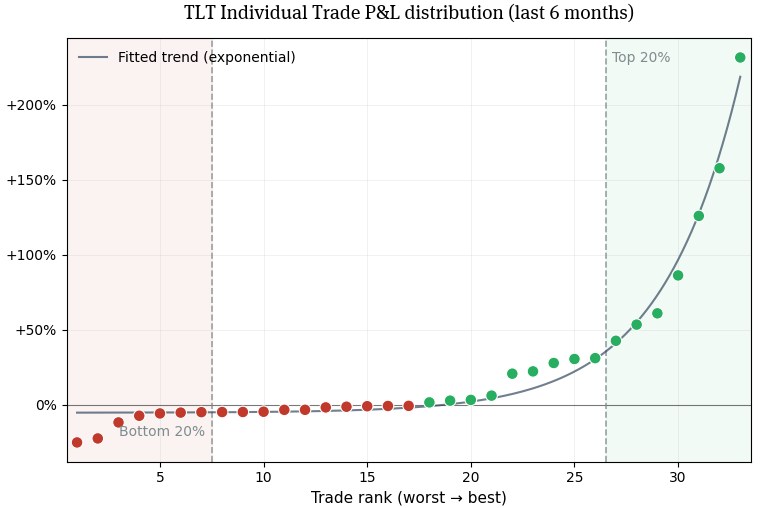
If we look back at the individual trades for the last six months, about 18% of the trades are doing the majority of the work, with the rest showing either modest returns or losses. In fact, almost half of the individual trades show losses, most small and less than 5%, but a handful are greater than that, and two are above -20%.
This distribution in the system is working exactly as designed, not in spite of those losers but because of them. The same rules that allow underperforming stocks to experience occasional -25% drawdowns also enable successful stocks to grow into +231% positions. As long as the losses are kept in check, we can compensate with a smaller pool of outsized gains. You don’t get one without the other. You don’t get the wave of your life without paddling through some chop.

When to Paddle In
You may have picked up on a tension I’ve so far overlooked in the article. Trading (and surfing) is not as simple as “stay in the water at all times, no matter what”.
Every one of our strategies has a regime filter, a rule that takes a portfolio to cash when broader market conditions deteriorate badly. The metaphor reconciles neatly enough: when the wave height across the whole break collapses and the wind turns onshore, you’re not missing barrels by paddling in. You’re avoiding getting thrown against the rocks. Over the long run, sitting out the worst stretches preserves more capital than it costs in missed upside, and the backtests bear that out across every system we run.
Earlier this year, when the Iran conflict triggered a sharp risk-off move, that filter did exactly what it was built to do. Several of our strategies went to cash; they were on the sand, watching, while the market chopped and then, to the surprise of plenty of professionals, turned and ran. Those portfolios missed waves they would otherwise have caught. But that’s not a failure of the rules; it’s the rules working as designed, accepting a known cost (occasionally missing a recovery) in exchange for a known benefit (not riding a genuinely hazardous market environment down). Run the same filter across decades of data, and the trade-off is overwhelmingly worth it. A few painful misses are the cost of avoiding genuine disasters.
In fact, the monthly side of the Trade Long Term only missed the exit cut off by a very narrow margin, while the weekly side exited around that point and paddled into shore alongside the other US strategies. But that’s not because the monthly side knew something that the weekly side or other strategies didn’t. This is simply because the same rules that protected the weekly side and other strategies from a potentially worse outcome positioned the monthly side for the recovery that actually occurred. That’s strategy diversification in action.
But if we flipped the script and the market had rolled over instead of making a quick reversal, the strategies that went to cash would be the ones we’d be writing about, and Trade Long Term monthly would be the one nursing losses. Occasionally the filter saves you. Occasionally it costs you. Across enough trades and cycles, the maths works. But no single instance ever proves or disproves the rule.
Sitting in the Water

The single hardest thing about trading these systems is not the entries, the exits, the position sizing, or the code. It’s the sitting. The challenge lies in being at the back, in calm water, after a year like 2025 (or a year of losses), and resisting the urge to paddle in. A few things can help.
Understanding the maths is one. When you’ve observed numerous backtests and real-time data that show that the distribution of returns is wildly skewed with a small number of trades generating the majority of profits, you begin to recognise the flat patches for what they truly are. They are not evidence that the system is broken; they are simply the cost of participation. The pro surfer does not paddle in when they haven’t caught a wave in the last 10 minutes. They understand that waiting on their board is an integral part of the game.
Looking at the data is another. Had someone told me in December 2024 that the next 18 months would yield a +231% trade in Micron, I would have been ecstatic. The reality is I wasn’t told. Nobody was. The position that produced that gain looked, on the day of entry, exactly like every other entry: ordinary, uncertain, just another paddle for a wave that might or might not break. The MU entry didn’t feel like the wave of the year. None of them do; they only feel that way in retrospect.
Lastly, the metaphor itself helps. The surfer knows that paddling back because nothing has happened yet is the wrong decision. Just as the fisherman knows, changing his bait every five minutes won’t encourage more bites. Or just as a poker player knows that hours of bluffing and folding keep you at the table for when the cards are right. There’s a difference between paddling in because a storm has rolled in and paddling in because you’re bored. The rules recognise that difference. You just have to trust them.
Maybe I should have taken the surfing class.