The Post-AI Stock Market
A computer can never be held accountable,
therefore a computer should never make a management decision.
This is a quote from a 1979 IBM training manual.
To a reader in 2026, it reads as a prophecy from an unnamed author foreseeing the rise of artificial intelligence and foreboding the dangers therein.
More than likely, however, they were talking about VisiCalc, the first-ever spreadsheet software released the same year, and warning employees that they couldn’t blame their decisions on the computer should it lead them to a bad outcome.
Regardless, the original quote has become increasingly insightful as the years have passed and technology has evolved. And yet, it seems like many people have not heeded this warning from 47 years ago.
People are becoming more and more willing to defer their judgement to AI systems, and we’re now seeing claims of “full AI trading systems” and “AI fund managers.”
But these solutions appear to be making a false promise to those who do not fully understand AI and see it as a solve-all for their trade woes.
Here are my thoughts on the subject as both a software engineer and a trader.
Note: When I mention ‘AI’ here, I mention it as we currently perceive it, that is, Large Language Models (LLMs).
A Misunderstanding – What is AI?
Ultimately, AI has the same trading tools available to humans and the algorithms already developed by humans, which means it operates within the same constraints and limitations as human traders.
An AI, as we know it, is not an omniscient quantum computer. It cannot tell the future.
Like humans, AI can only digest existing information and data to make predictions. Just like humans, AI does not have access to a dataset explaining the entire universe. Such a thing can never exist, because the only data set capable of achieving this goal is the universe itself.
If a computer did have access to that kind of knowledge and the ability to act on it, the market as we know it would serve no purpose and cease to exist entirely.
How Would an AI Trade?
Therefore, as an AI is not omniscient, it is not a purely rational being.
In order to trade, the AI must take inputs, apply rules, and use them to produce outputs. This is by definition a trading strategy. Even if you cannot see the rules being used, they exist in some form within. The AI is not reasoning by way of magic, but rather, some internally defined ruleset.
Because an AI’s outputs are entirely dependent on its inputs, AI models suffer input biases based on its training data, which can lead to skewed decision-making and performance issues in trading scenarios. Inherently then, an AI’s strategy will have the same limitations and pitfalls as any traditional algorithmic trading strategy.
An AI Market
Though the speed and character of the market could be dramatically altered by the deployment of AI bots, its underlying nature and market forces will remain unchanged. This is because the basic tenets of supply and demand will still hold true.
Because it is not omniscient, AI is not immune to the unknown, and therefore it is susceptible to supply shocks, natural disasters, and the irrationality of the broader market.
Two AI trading bots built on different models and fed slightly different input data may come to entirely different trading decisions. Just like two human traders, then, one’s decision may be to the benefit or the detriment of the other.
Irrationality and inefficiencies will continue to exist in the market because each individual AI and human market participant has access to different information. Furthermore, an AI can still receive and act on false or misleading information, just as a human would. Therefore, market anomalies such as momentum and mean reversion will continue to exist, even if their manifestation changes.
There is no evidence to suggest a million AI bots fighting it out in the market will result in a market fundamentally different to a million humans fighting it out, because irrationality still exists and price still obeys the laws of supply and demand.
If one AI trader is placing institutional-sized long-term investments, there is nothing to stop another AI bot (or human) from front-running or scalping around these orders, seeking to exploit the same market inefficiencies that are today exploitable.
AI Trading Still Needs Humans
Fully automated trading strategies have existed for years, and yet, many people with the means of running such a thing do not do so. Why?
They lack the trust, discipline, or mental fortitude to let an algorithm control their finances, even if they understand how that algorithm operates.
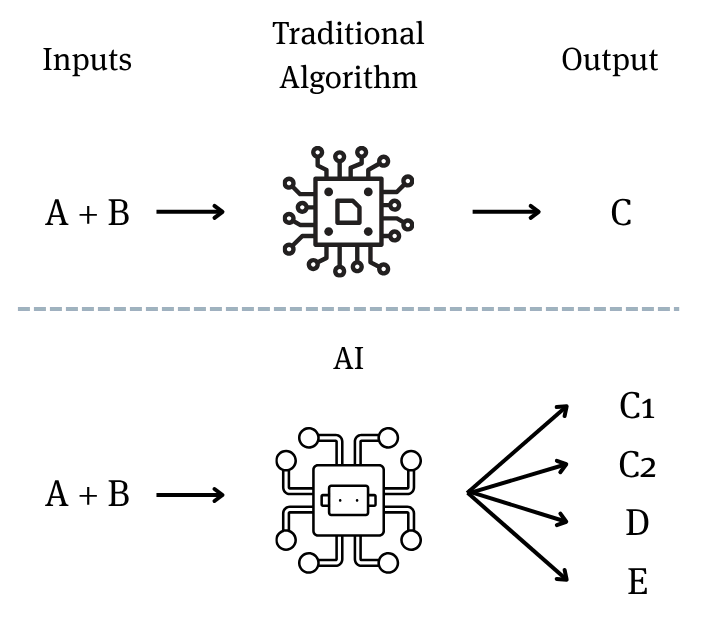
A traditional algorithmic strategy has clearly defined rules, where one set of input data will always produce the same resulting output. For example, a strategy may filter stocks based on their turnover and then pick the top 10 remaining based on their rate of change. With such clearly defined rules, the same input will always produce the same output.
Conversely, the same inputs into an AI can result in an entirely different output. This can range from the same answer in slightly different wording to an entirely different answer.
Thus, with a traditional algorithm, A + B will always equal C. With an AI trading system however, A + B will not always equal C.
A trader then, could run two versions of the exact same AI trading system, at the exact same time, and with the exact same input data, yet receive two conflicting outputs; which then, is correct?
When markets start to turn and losses start to mount, will you continue to trust your money to an AI whose thought process you have no real ability to understand?
Human emotions already make people pull the plug on their algorithmic trading strategies; it is reasonable to expect this would also apply to an AI trading bot.
This, of course, will not be a problem for experienced or institutional investors who have the nerve and fortitude for trading already. However, the human psychological limitations that currently affect algorithmic trading will also persist with AI trading; somebody who would override or pull the plug on an algorithmic strategy, is arguably more likely to override an AI trading system.
The AI Fund Manager
Despite the above, recently there have been many attempts to establish an “AI fund manager” capable of running a trading fund with no human input. But how would this function when we consider the premise of the IBM quotation at the beginning of the article?
It presents a valid question and criticism concerning an “AI fund manager”. If you were to invest in a fund run by an AI and something went wrong, who or what would be responsible?
Ultimately, the AI cannot think and does not exist as a legal entity. Therefore, who then is responsible for any failings: performance, regulatory, or otherwise?
Is responsibility attributed to the company that built the AI model, the team that trained it, the person who prompted it, the directors who own the AI fund manager, or the trader who invests their funds through the AI?
Ultimately, all of these people had input into how the AI functions, and yet none of them had any direct input into how the AI reached or executed its final decision. If, then, the AI were to break the law through market manipulation in its instructions to return a profit, who would be responsible and who would face the consequences?
The AI Fund Manager’s Manager
Of course, guard rails can be put around AI. Limitations can be applied to constrain what an AI may or may not do. These human-applied restraints, then, take on a strange inversion of a trading algorithm as we currently know it; instead of building rules from the ground up to define how trades should be done, we apply restrictions from above to define how trades shouldn’t be done.
With such controls applied, we can see the AI becomes no longer a “thinking” machine but merely a machine capable of processing data in an abstract way that a traditional algorithm cannot.
Because a person must be ultimately responsible for maintaining the AI’s constraints and performance, as well as being the person liable should anything go wrong, a manager in charge of the AI fund manager is now necessary.
Paradoxically then, the smarter the AI becomes, the more necessary human oversight of its actions becomes.
AI, as it currently exists, will not eliminate the need for traders. However, the role of a trader may shift dramatically in the years to come.
As AI has not yet proven itself capable of acting fully autonomously without human intervention, the trader of the future is not fighting against an AI but someone working to keep an AI functional and in check.
The unnamed IBM author in 1979 said a computer must never make a management decision, and they were right, but probably not in the way they expected.